A $140M Series B, and no AI product yet
A million businesses use Manychat to automate conversations on Instagram, WhatsApp and Messenger. After a $140M Series B it needed AI inside those conversations, and had none of the patterns or standards that requires.
Before: automation as a hand-built rule
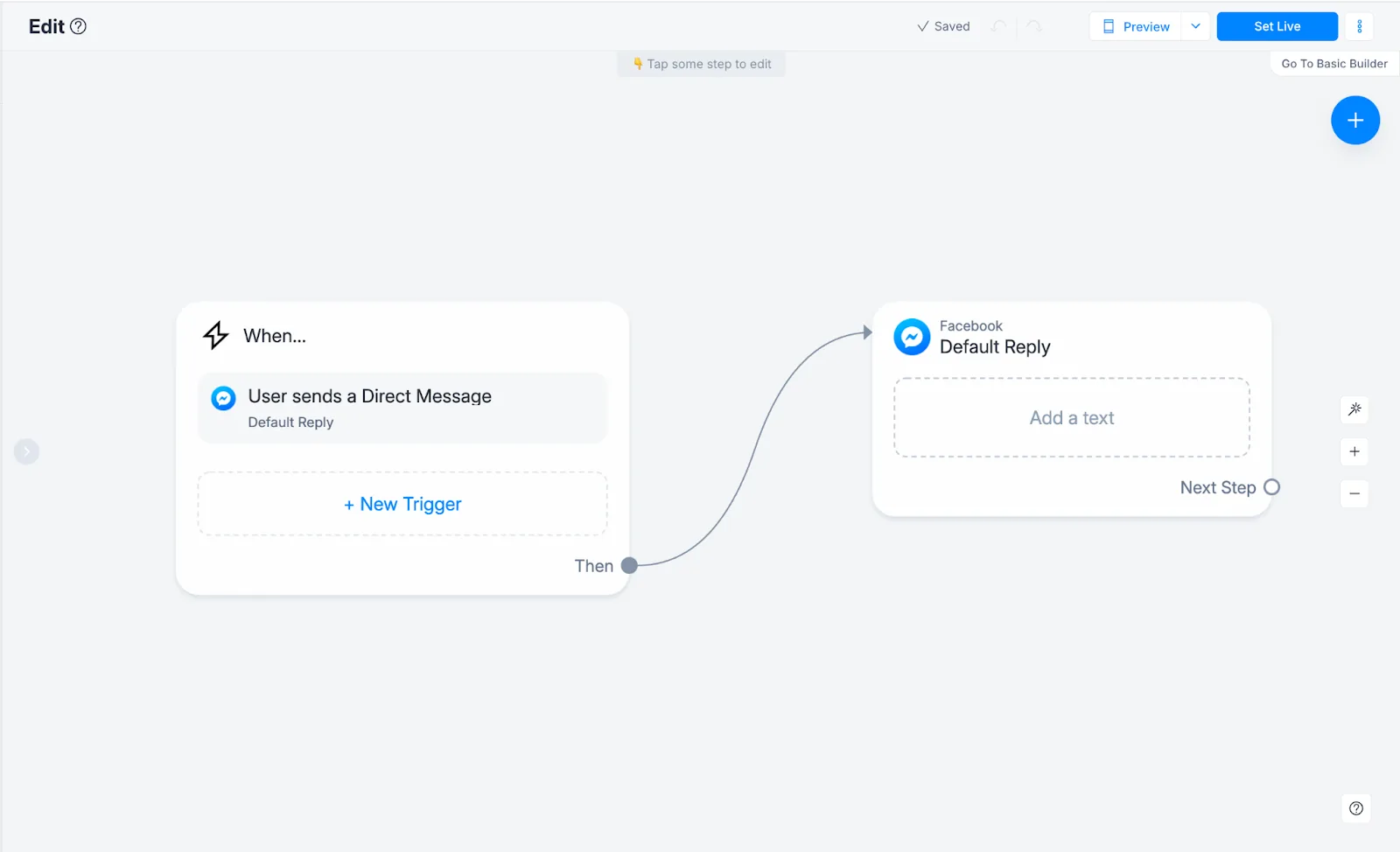
Every reply was a branch drawn by hand. Predictable, inspectable, bounded. That is the bar an AI reply had to clear.
Ship the first AI products. Build the system to scale them.
- Take Manychat's first AI products, AI Behaviour and AI Replies, from zero to one, and own the design quality bar for every AI surface
- Create and lead the AI Design Playbook: how the company designs AI products
- Own the design system roadmap and rebuild its foundations for a faster AI cadence
- Own content design: the team, its operations and a new set of guidelines
- Manage seven senior, staff and content designers across two teams
Nobody had done this here before
No prior AI feature to learn from, so discovery worked backward from the automations people already trusted.
The gap was not capability, it was configuration. Someone setting up AI had no way to tell it who to sound like or what never to say. That became the brief.
Zero to one, with no shared language for AI
Every designer touching an AI surface was inventing its patterns alone: how to show confidence, when to ask permission, how the AI sounds. Without a standard, every feature ships as a one-off.
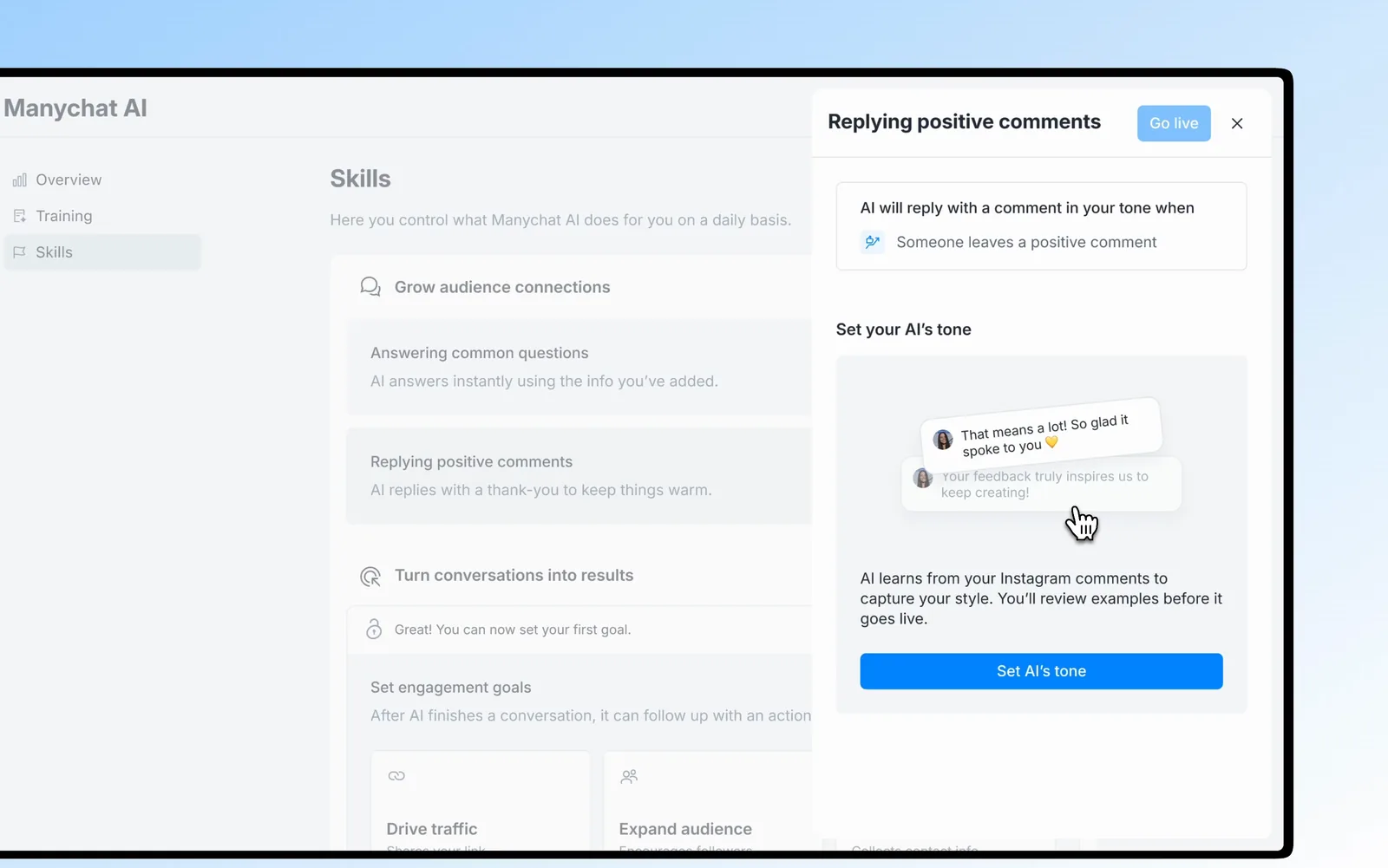
Teaching tone from the business's own conversations, not a blank field
AI BehaviourAI Behaviour: give it a starting point, not a blank form
Nobody can describe their own brand voice into an empty box, so the setup never shows one. It learns tone from conversations the business has already had, and asks the owner to approve or reject real examples.
Guardrails mattered more. When a question crosses one, the AI declines rather than improvises.
Configuring the skill, and the preview where the AI declines to guess
AI Replies: close the knowledge gap in the same flow that found it
AI Replies answers only from what the business has taught it. Where it has nothing it says so, and the gap is fillable without leaving the screen that found it.
When it still cannot, the conversation goes to a person. A confident wrong answer lands in a customer's inbox.
The playbook behind both of them
Every decision made shipping those two became the AI Design Playbook. Its organising idea: AI features are not a category, they are a set of jobs. Clustering has nothing in common with drafting, so it is indexed by job, not by screen.
The people who had to use it wrote it
I led the Playbook. The designers working on AI, automations and inbox wrote it with me. Nobody needs persuading to follow a standard they authored, which is the cheapest adoption mechanism a design leader has.
It spread through AI-native sessions rather than a launch announcement. Then it left design altogether: product and customer success now use its skills to explore and prototype their own ideas. That is the point at which a design standard stops being a design document.
Design system foundations, rebuilt for AI-product speed
The system held a stable library. AI products needed it to absorb new patterns continuously. I led the rebuild alongside the AI work, so every pattern shipped as a documented component.
I ran a workshop with the people who use the system daily, across design, engineering, content and brand, and had them cluster the problems. The split decided the roadmap.
The second cluster mattered more. Any competent team can rebuild a library. A system where nobody knows who decides decays again within six months.
So what got built was not a library. It is one source of truth across design, engineering, content and brand, with a contribution and approval model attached: who proposes a change, who signs it off, how it versions. Cross-platform parity and WCAG 2.1 AA are defaults in it, not a later pass.
An AI product speaks twice
The AI talks to the business's customer. The product talks to the business owner about the AI: what it is about to do, what it will not do, what it did last week. Collapse those two voices and the product starts impersonating the thing it is meant to be explaining.
So content design sat inside both teams rather than reviewing their output at the end. New guidelines set which voice owns which moment, and the same terminology went into the design system, so a component and its copy could not drift apart.
Three calls that shaped the outcome
Ship the product and the pattern language together
Waiting for a finished AI design system would have meant shipping nothing. The Playbook came out of building the real thing.
Trust is a design decision, not a legal disclaimer
Every AI surface had to show what it was about to do, and make it easy to undo. That shaped the interaction more than any feature request.
Content design is not a late pass on copy
Content design sat in both teams from day one, so AI voice and system terminology were decided alongside the interaction.
A validated AI product line, and a system to build the next one on
Both products shipped as betas to a segment of Manychat's users and generated $200K in revenue before general availability. That is what turned AI from an experiment into a funded product line. The next feature starts from the Playbook instead of a blank page.
Shipped: what the AI reports back to the business owner
The reporting surface closes the loop the preview opened: where the AI could not answer, the owner is shown the gap rather than finding it in a customer conversation.
What this changed
An AI feature isn't trustworthy because it works. It's trustworthy because the person using it can see what it's about to do.
The scope is what it cost. Two teams, four disciplines, and craft, strategy and hiring running together from the first week. I sat in the interviews and technical challenges for product designers, content designers, product managers and front-end engineers. That is a good use of a design leader, and it is also how a week disappears.
Focus here is something I fight for rather than something I have.
- Shipping the first AI product and writing the standard for the next one are the same job, in that order.
- A system built for AI-product speed absorbs new patterns constantly. A different discipline to maintaining a stable library.