Hyper growth, legacy product, new platform
Talkdesk is a Contact Center as a Service in hyper growth, moving from SMB into enterprise on a new cloud platform called Atlas. I joined a team of six designers to migrate a legacy admin experience into something that could carry that ambition.
A legacy product still in production, no documentation, and a company reorganising at pace. Design quality here was not about delight. It was trust and structural clarity at speed.
Design the new paradigm. Hire and scale the team.
- Create a new information architecture and experience paradigm for the CX Cloud platform
- Design and ship the new Admin app: user management, permissions, billing, workflow studio, reporting, WFM and AI
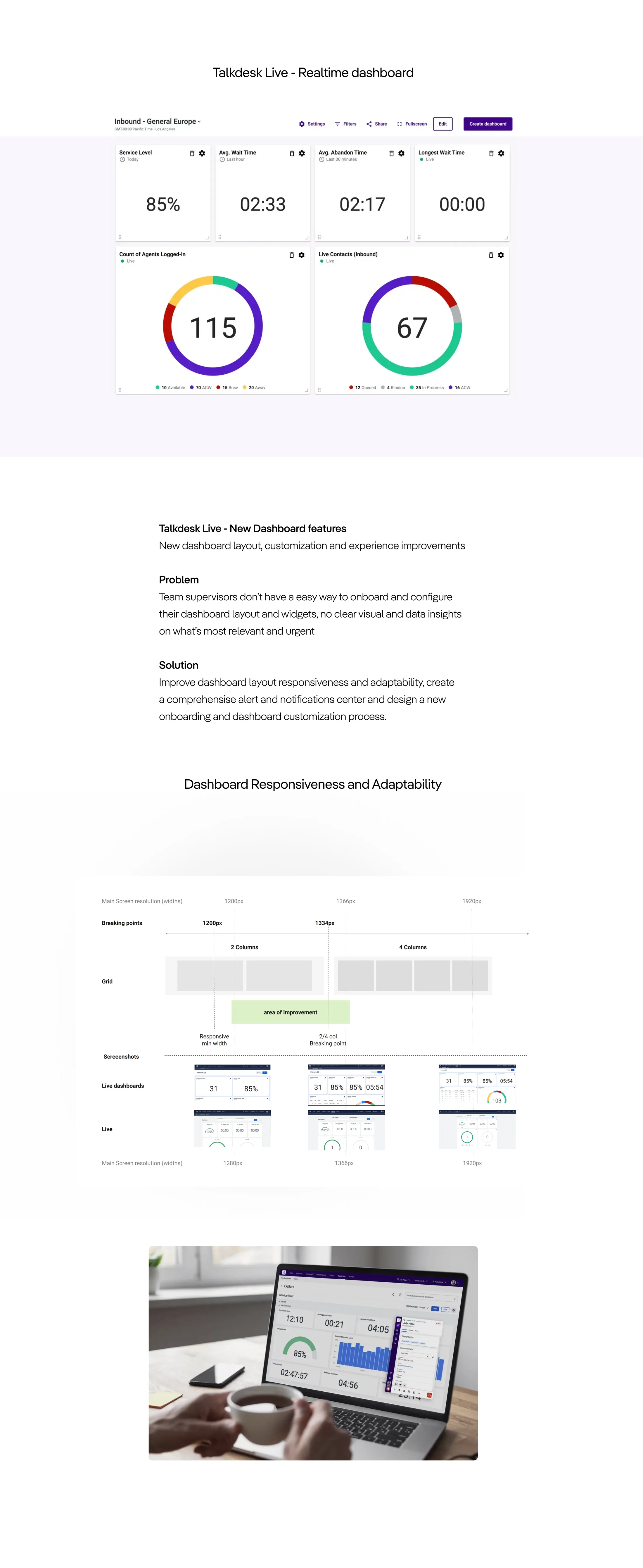
- Redesign Talkdesk Live: dashboard responsiveness, alerts centre, guided onboarding
- Manage 6 designers, and own hiring criteria, onboarding and process for an org scaling 6 to 60+
Map first, design second
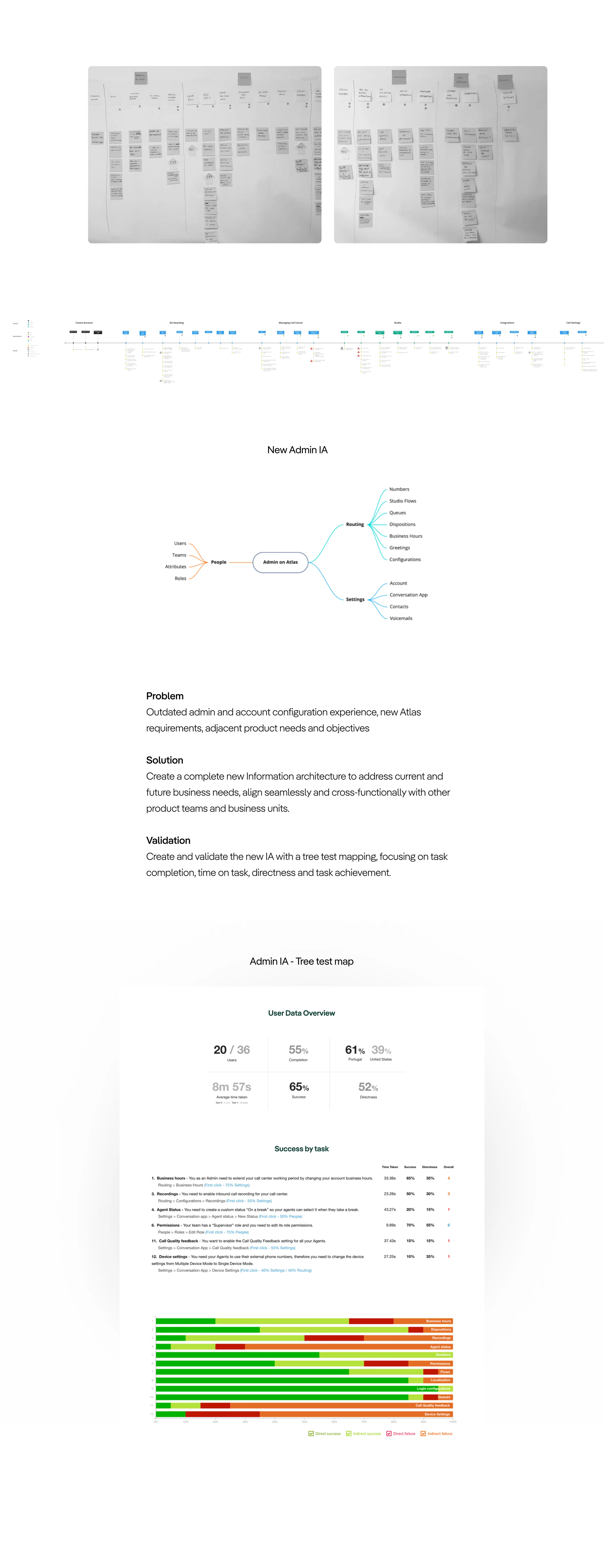
Before anything was designed I mapped every admin and product touchpoint across the legacy platform and the emerging Atlas suite, through co-creation sessions, customer interviews and cross-functional workshops. The new Admin architecture was then validated with a tree test, measuring task completion, time on task and directness before a single component was built.
A new platform experience
The legacy admin experience had years of accumulated scope and could not be patched into Atlas. Every product team had built its own configuration touchpoints. No coherent structure, no shared model, nothing to build on.

Problem. Legacy admin and call center configuration experience, new Atlas platform functional and visual requirements.
Solution. A new admin and configuration app for Atlas: user management and permissions, billing, workflow studio, reporting, WFM and AI.
 The Work
Platform design at enterprise depth
The Admin work was the heaviest: an entirely new configuration app covering user management, permissions, billing, workflow studio, reporting, WFM and AI. Every surface had to hold up under enterprise procurement scrutiny.
Talkdesk Live ran in parallel: responsive dashboards, a new alerts centre, and onboarding that let supervisors configure their own workspace without support.
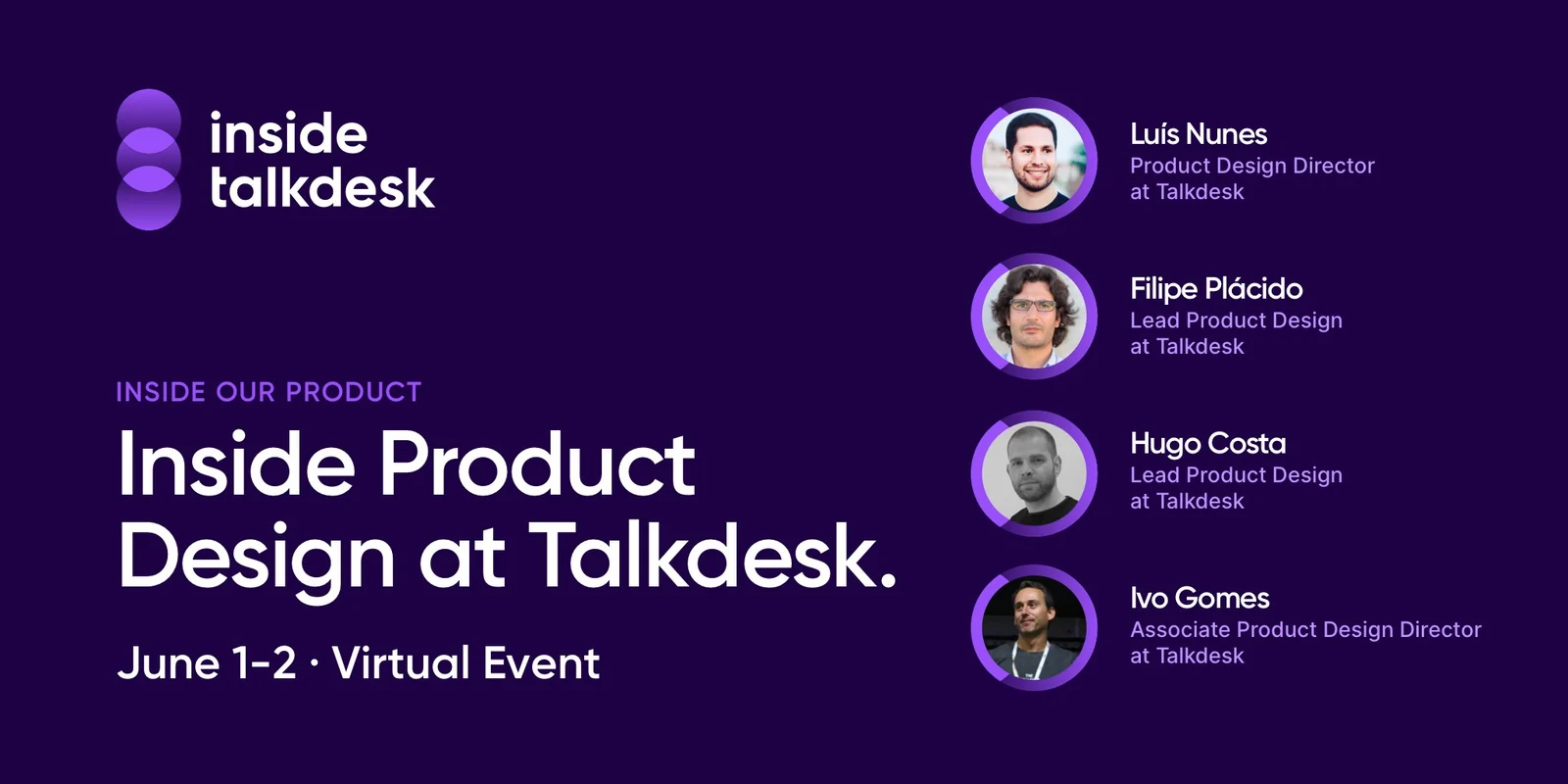
Four speakers from the design org, June 2021

Product design process at Talkdesk
The first time design presented at the company keynote. My session covered how product design actually ran here: its drivers, tools and systems.

Product design community workshops
Problem. The design org grew tenfold in three years. Process and communication strained. Consistency suffered.
Solution. Surface the real problems, then co-define drivers and actions with the team itself. A clear structure made it possible to lead 60 designers remotely.
Workshop facilitation and documentation
Double Diamond structure across both sessions.

Product Design - Community drivers
The first session converged on four drivers: culture, collaboration, knowledge and consistency. The second assigned an owner to every action point.

Three calls that shaped the outcome
Treat the admin and configuration interface as a product
Not a settings page, not an afterthought. It's what enterprise buyers actually evaluate.
A reporting dashboard is a tool for decision-making
We stripped out what just proved the tool could do it, and rebuilt around what the reader needed to act on.
Invest in the org as much as the product
Design quality doesn't scale with headcount. It scales with the standards you build into the team.
What the work had to hold up to
Admin, Reporting and Billing were the surfaces renewal conversations turned on. I owned all three with a team of six, while the design org grew past sixty.
What this changed
The quality ceiling of a design organisation is set by its culture and processes, not its headcount.
Growing tenfold in three years cost convergence. Processes drifted, ways of working diverged, product consistency slipped, and the culture that held six designers did not stretch to sixty on its own.
The workshop was the diagnosis, not an offsite. The four drivers the org named for itself were exactly what growth had quietly taken. My job was not to spot the damage. It was to get sixty people to name it, and then own the fix.